
USMLE 2026 Changes: New Test Software, Portals, and Block Structure Explained
The USMLE is rolling out its biggest administrative overhaul in years, and a lot of test-takers don't know about it yet. Starting March 10, 2026, Step 3 moves to new test delivery software, with Step 1 and Step 2 CK following in Q2 2026.
Here's what's actually changing, what isn't, and what you need to do about it.
The Exam Content Has Not Changed
This is the most important thing to understand. The USMLE changes in 2026 are entirely administrative and logistical. The exam content, scoring methodology, pass/fail policies, eligibility requirements, and total number of questions are all staying exactly the same. If you've been studying for Step 1, Step 2 CK, or Step 3, nothing about your preparation needs to change.
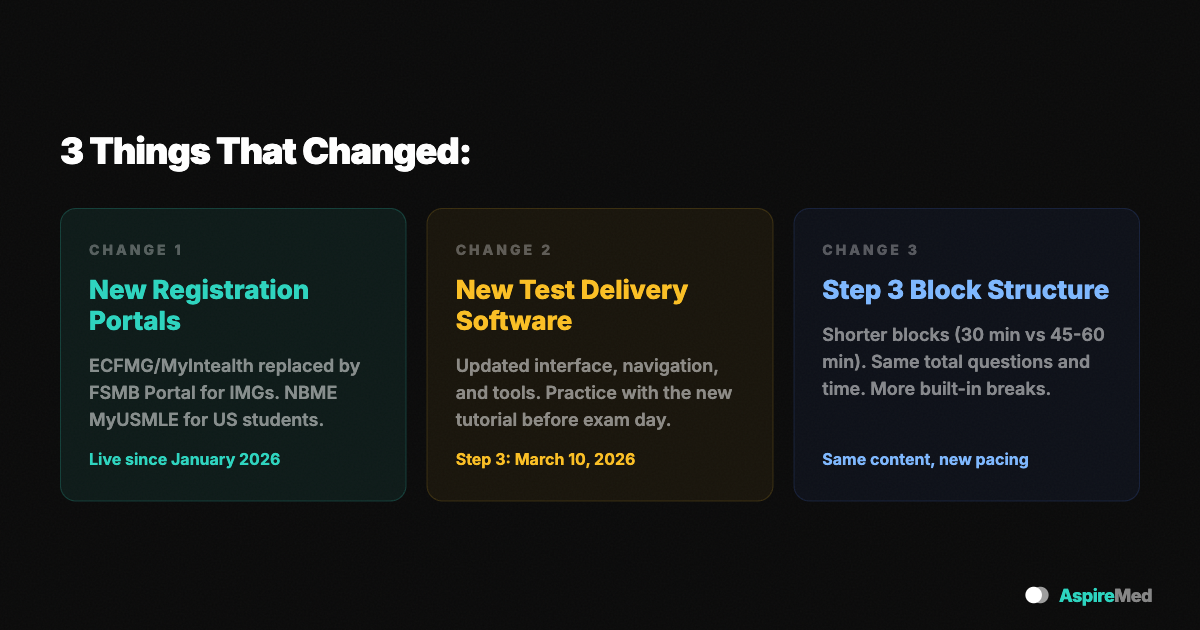
New Registration Portals
Both US medical students and international medical graduates have been migrated to new registration portals.
For IMGs: Step exam services moved from ECFMG/MyIntealth to the FSMB USMLE portal as of January 12, 2026. If you previously managed your Step registrations through ECFMG, you now go through FSMB. Your exam history and eligibility have transferred over, but you'll need to create an account on the new portal.
For US medical students: All Step services moved to NBME's MyUSMLE portal as of January 26, 2026. This consolidates everything into one place — scheduling, score reports, and registration.
The portal migration is already complete. If you haven't logged into the new portal yet, do it before your next exam to make sure your information transferred correctly.
New Test Delivery Software
This is the change that will feel different on exam day. The USMLE is transitioning to new test delivery software with an updated interface and navigation. The software rollout is staggered:
Step 3: New software goes live March 10, 2026. If your Step 3 exam is scheduled on or after this date, you'll be using the new interface.
Step 1 and Step 2 CK: New software arrives in Q2 2026. The exact date hasn't been announced yet.
If you have an exam scheduled before these dates, you'll take it on the current software. If your exam is after, you'll use the new version. There's no overlap or choice involved — it's determined by your exam date.
Step 3 Block Structure Changes
Along with the new software, Step 3 is getting a restructured block format. The total number of questions and total testing time remain the same, but the blocks are shorter with fewer questions each.
Day 1 (Foundations of Independent Practice): Previously 6 blocks with 38-39 questions and 60 minutes each. Now 12 blocks with 18-20 questions and 30 minutes each.
Day 2 (Advanced Clinical Medicine): Previously 6 MCQ blocks with 30 questions and 45 minutes each. Now 9 MCQ blocks with 20 questions and 30 minutes each.
The case simulations (CCS) on Day 2 remain unchanged.
The practical effect is that you'll have more frequent breaks between blocks, and each block will feel more manageable. Some test-takers may prefer this format since you can reset mentally more often. The total questions and total time commitment are the same as before, so the overall difficulty and stamina requirements haven't changed.
What You Should Do
If your exam is before March 10 (Step 3) or before Q2 2026 (Step 1/2 CK): Nothing. You're taking the exam on the current software.
If your exam is after those dates: Practice with the new software tutorial before test day. The USMLE will provide a practice interface so you can get familiar with the navigation, question layout, and tools. Don't walk in cold — even small interface changes can throw you off under exam pressure.
Regardless of timing: Make sure you've logged into your new portal (FSMB for IMGs, MyUSMLE for US students) and confirmed your information is correct.
What This Means for Your Opportunities
Many research positions, fellowships, and residency programs have Step score requirements or preferences. These requirements are not affected by the 2026 changes since the exam content and scoring are identical.
If you're searching for opportunities that list Step score requirements, browse on AspireMed where every listing includes eligibility details, deadlines, and direct application links across 40+ specialties.
Sources: USMLE.org — Test Delivery Software Updates Coming in 2026
Get career guides in your inbox
Join medical trainees getting opportunity alerts and career guides. Free, no spam, unsubscribe anytime.
Find your next opportunity
Browse hundreds of medical opportunities with Altus matching, free for all trainees.